
The firm allows −$5,000 a day. At −$4,500 the trades close and copies wait, so a slipped stop is far more likely to cost you the day than the account.
Set a buffer inside each firm's daily loss. When an account reaches it, its trades close and the others carry on.
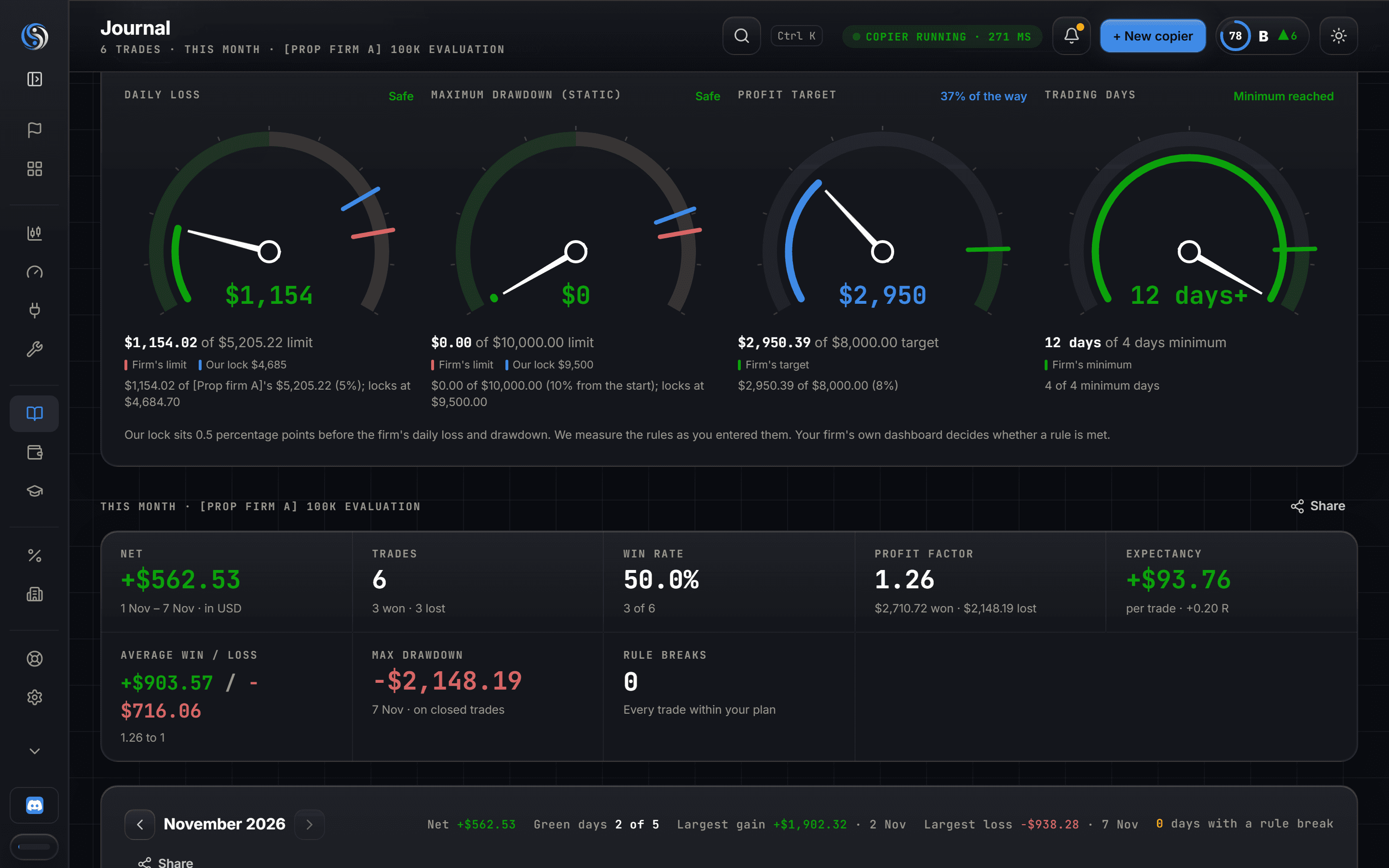
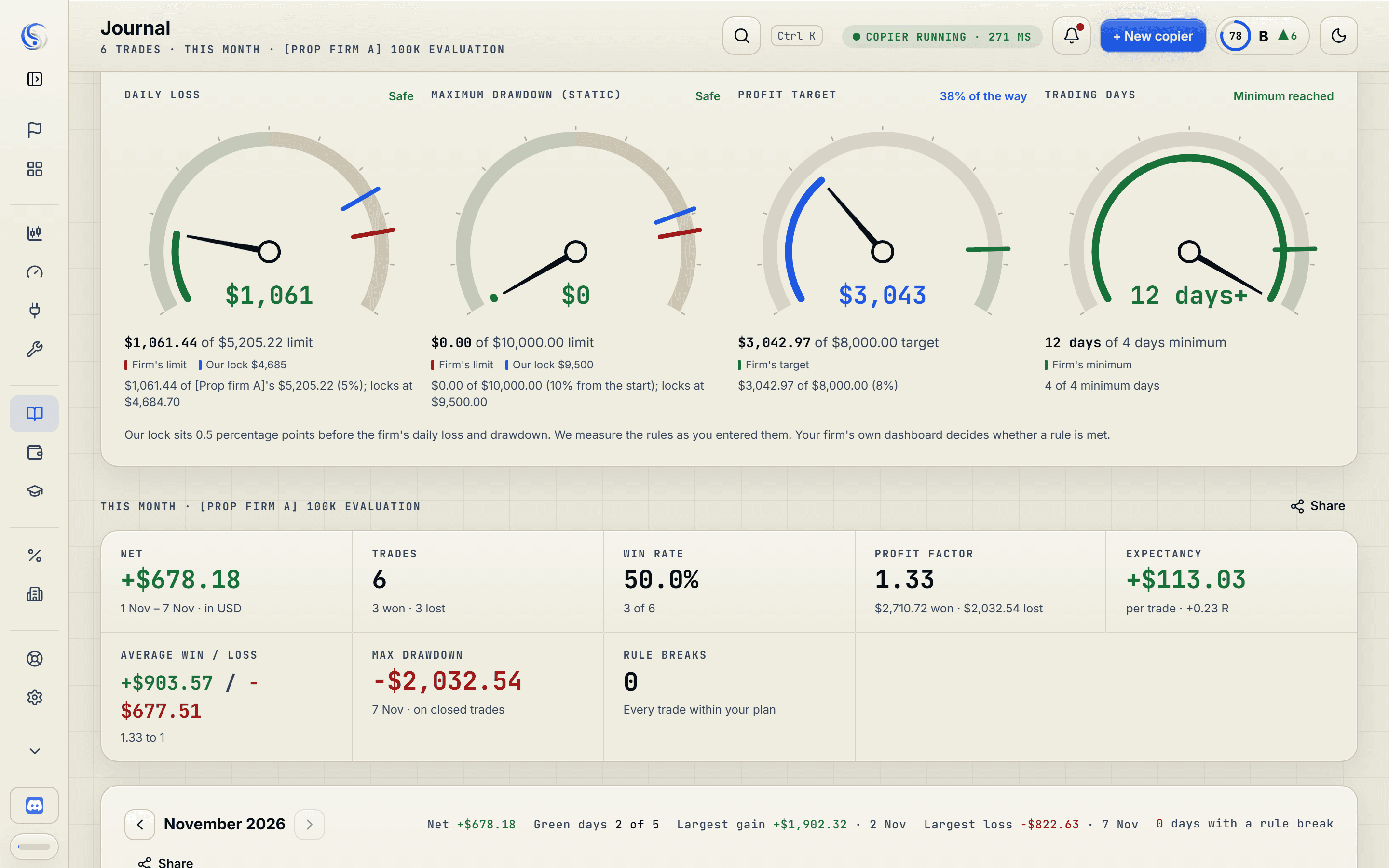
One challenge account in the Journal. Each rule on its own dial, with the firm's limit and your buffer marked.
Three steps. Then your normal trading day.
Enter the firm's daily loss, drawdown, target, consistency rule and minimum days.
A lock a few points inside the firm's limit, plus your own rules for the day.
Every account takes the trade at its own size. One locks, the rest carry on.
One $100,000 challenge, worked out.
The firm allows −$5,000 a day. At −$4,500 the trades close and copies wait, so a slipped stop is far more likely to cost you the day than the account.
A 30-minute cool-off after a loss, and a lock after three losses in a row. A revenge trade during the lock is closed as soon as we see it.
A trade over the cap is trimmed or closed a moment after the fill. Your own and your channels' trades get a missing stop and target. Copies keep the copier's own stops.
The firm measures your daily loss after slippage, on its own clock. The lock sits a few points inside it.
This account's trades close and its copies wait for the firm's reset. Every other account carries on.
Enter each account's rules once. The dials stay current from the account itself.
A $549 challenge and a $149 reset against a $2,140 payout leaves that firm $1,442 ahead for you.
Four challenge accounts following one Provider place four trades in the same direction at close to the same time.
Paid plans start with 7 days free. Three tools on one challenge account is three connections.
Four more parts of the workspace, each already set up for a challenge account.
Each challenge account sized to its own balance, with its tools checked before every copy.
See how it worksProp gauges, rule checks, the Solution Score and Stark, your AI coach.
See how it worksYour manual trades meet the same locks as your copies.
See how it worksEach firm's fees against its payouts, beside your other costs.
See how it worksWe make no such claim, and we make no promise about passing. Firms enforce their own rules. They differ by firm, they change, and some limit copying. Read your firm's rules, set our buffer inside their limits, and ask the firm when in doubt.
Yes. Four Followers on one Provider place four trades in the same direction at close to the same time. Whether that is allowed is the firm's rule, and firms differ. Read yours, and ask the firm when in doubt.
Yes. Each Follower has its own size rule and its own tools, so challenge accounts of different sizes, at different firms, on different platforms can follow the same Provider.
MT4, MT5, cTrader, Tradovate, NinjaTrader. MetaTrader accounts connect through your own MetaApi key; cTrader, Tradovate and NinjaTrader accounts connect when you sign in on their own page. Futures accounts follow contract rules, such as ES to MES × 10.
By its own rule, from its own balance. At 0.5% risk and a 25-pip stop, a 50k account takes 1.00 lot ($250 at risk), a 100k account 2.00 lots ($500) and a 200k account 4.00 lots ($1,000). Aegis's risk cap and the firm's risk per trade in Heimdall act on the trades you place yourself, not on copies, so set each Follower's size to fit the firm's rule.
Heimdall stops that account: the trades we placed on it are closed (every trade on it, if you apply the tool to the whole account), and new trades and copies to it wait until the firm's reset, or until you lift the lock by typing the sentence, whichever comes first. Every other Follower carries on. Copies it held are not sent later.
One of two ways, whichever comes first: it releases by itself at the tool's reset (Monday's for a weekly rule), or you lift it early by typing I choose to trade past my limit today, word for word, so a lock never comes off by a mis-click. The journal records a lift, and the Solution Score counts it against discipline.
Around a high-impact release, a tool that is on also holds your manual trades on that account.
Each tool is switched on per account in the Toolkit, with its own settings. Before you save, the check names which tool locks first: “Heimdall locks at −4.5%, before Vigil's −5%”. On each account, copies keep the copier's own stops and Aegis looks after your other trades.
It looks after your own trades and the signal copier's trades once they open. A trade without a stop gets one, and a target too: the starting distance comes from the trading style in your answers, and you can change it. The stop moves to breakeven at the first take-profit, and a trailing stop takes the rest. Its risk cap, your risk per trade (0.5% on a prop account), trims or closes a trade over it a moment after the fill. Copies keep the copier's own stop settings, and it never locks the account.
No. The gauges follow the rules you enter and stay current from the account itself: profit target, daily loss, drawdown (static or trailing), consistency and trading days. Your firm's own dashboard is the final word on your account.
Payouts count as money earned, and challenge fees and resets as money spent, so each firm shows what it has cost you and what it has paid.
2 accounts for your journal, plus the free indicators and tools to download. The copier and the three cloud tools, Aegis, the PnL manager, Vigil, the discipline guard, and Heimdall, the prop firm rule manager, come with Starter, Pro and Hedge, each with a 7-day free trial.
No. Members see offers from prop firms we work with in the workspace, but we do not sell challenges or take a view on which firm to use.
Join free and tell us about your accounts and firms. Your workspace opens with the prop gauges, the Toolkit and cash flow set up around your answers. Paid plans start with 7 days free.